
The Models Predict by the Hour. The Buy Settles by the Week.
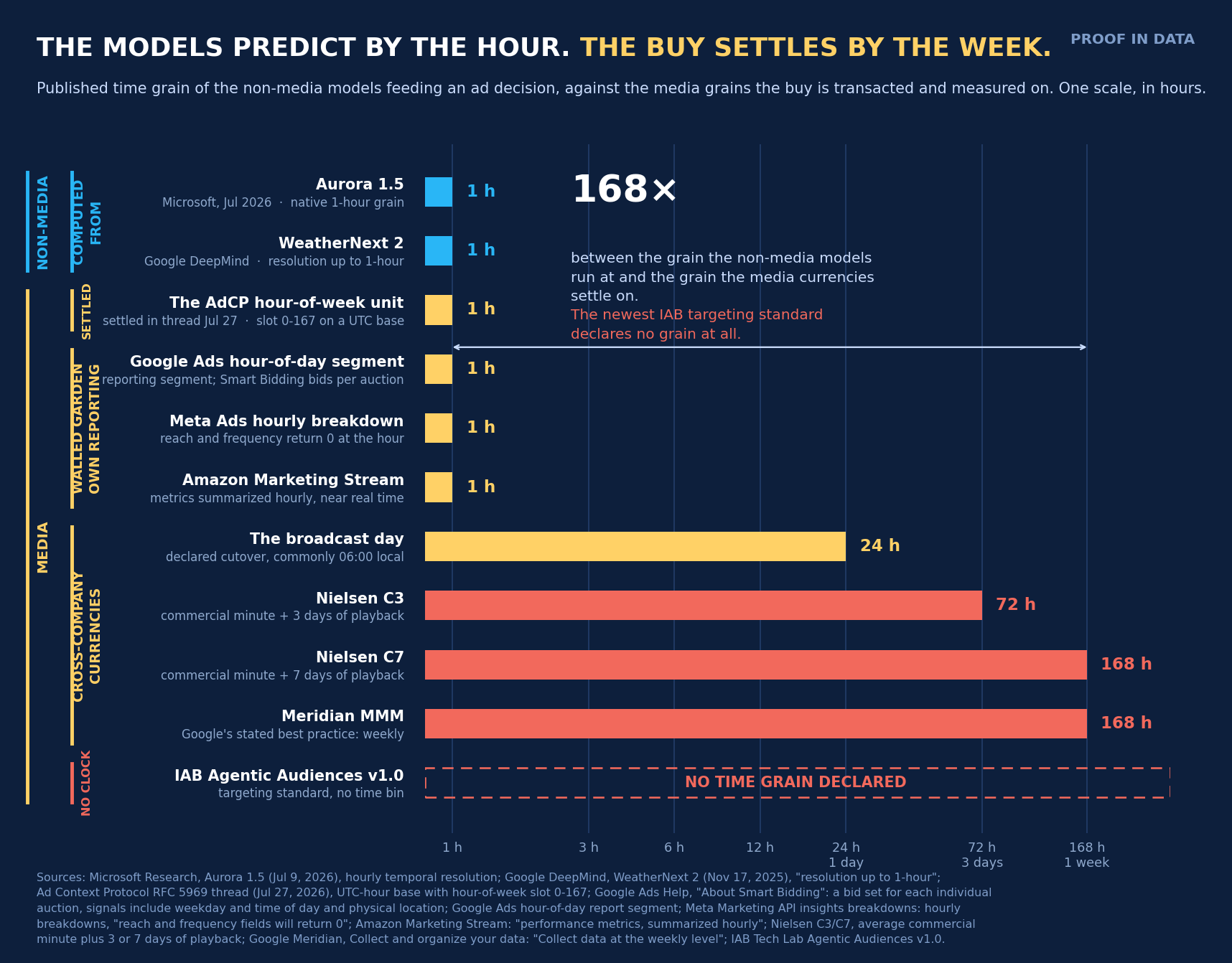
Auctions clear in milliseconds, but the numbers that decide what the money bought, Nielsen's currencies and Google's mix models, run on three days, seven days, and a week. A public spec just set advertising's clock to the hour.
Nate Woodman · August 3, 2026
Digital media needs a modern standard for time. It has to run through targeting, measurement, optimization, and reporting, and it has to match the granularity of the algorithms that read it. The algorithms run at the hour or finer. The week is traditional media's clock.
That standard is now in public draft. On July 27, the review thread of the Ad Context Protocol settled its base time unit: the hour, on a single global clock, with the broadcast day carried as a declared, versioned conversion.1 Evgeny Popov and I wrote the proposal, so read everything below knowing that.
Geography settled the day before in the same thread: a buy or a report declares its cell system, a uniform grid such as H3 hexagons, and the resolution it uses, instead of each platform naming geography its own way.1 Time was the last open dimension. The models feeding an ad decision publish hourly numbers. The currencies the industry settles money on run three days, seven days, or a week. A week holds 168 hours.
The open web competes with the walled gardens only when targeting, measurement, optimization, and reporting run on the same clock.
The hourly side is new, and the new models are AI, but they are not LLMs. Microsoft's Aurora 1.5 and Google's WeatherNext 2 are models of the physical world, and time is native to them. Aurora shipped July 9 with a one-hour grain and beat the ECMWF ensemble on 88.9 percent of evaluated targets.2 WeatherNext 2 has served hourly forecasts out of BigQuery since November.3 The weekly side is the incumbent. Nielsen's C3 and C7 average the commercial minute across three and seven days of playback.4 Google's mix modeling library says collect weekly.5 The broadcast day runs 24 hours from a cutover each market picks.
The walled gardens already run on the finer grain and declare none of it, because the same company sits on both sides of the trade. Their own documents say so: Google lists time of day and physical location among the signals Smart Bidding reads for each auction, Meta's click-prediction research names local time of day as a feature and keeps the rest unpublished by policy, and Amazon streams hourly metrics so advertisers can raise bids in the hours that perform.6
The open web matches that grain only by agreement, because its stack spans companies. A DSP paces the spend, a measurement vendor scores the outcome, and the vendor's hourly result only feeds the DSP's bidder when both mean the same hour. The constraint puts time in the standards bodies rather than in any one vendor's schema.
The clock also decides whether anyone can check the gardens' numbers. A garden's reported result is internal measurement. The external checks are geo experiments and the mix models calibrated to them, and Google ships both sides: Meridian wants weekly data, and GeoX runs the experiments beside it.5 Calibration is a comparison, and a comparison needs both sides in the same units. A shared clock lets the external number check the internal one.
Inside a garden, reach is a count of the garden's own logged-in accounts, a unit nobody else can count. The standard does not ask for that count. It asks for impressions reported by cell and hour, and impressions are enough for external counting, validation, and alignment across systems. Meta's hourly breakdowns already carry impressions and return zero for reach and frequency.7 Reach gets computed outside the garden, against a population, the people in a market during a window, and populations move. A residential cell holds its people at midnight, and by noon the same people sit in office cells across town. When no rule says which hour a population count came from, two sellers can report the same figure and mean different things.
"a reach or frequency figure computed against an undeclared grain isn't a bounded number"
Evgeny Popov, Ad Context Protocol, RFC 5969 thread, July 27, 20261
The newest targeting standard still declines to declare a grain: the IAB's Agentic Audiences, built to serve audience vectors into live buying, fixes the vector's dimensions and its serving latency and declares no time bin.8
The settled design is small and strict. The hour is the base unit. The broadcast day is a declared conversion, versioned with the dates it is valid between. A required field separates "hour 62 of the week," a slot in a repeating cycle, from "14:00 to 15:00 on July 25," an interval on the timeline. Daylight Saving Time is representable, because one day a year has 23 hours, one has 25, and a conversion that returns 24 every time is wrong twice a year and silent about it.1
Once the hour is a declared field, a buyer can price a buy against the hour it ran in and ask a seller which hour its population count came from. Until then the weekly number averages the hourly model away, and nobody can see what the averaging cost.
The first thing the declared clock will price is the gap between an hourly model and a weekly invoice.
The longer argument for both halves is in Marketers of Catan, the machine that consumes place and time is in How a Modern Ad Ranking System Works, and the proposal itself is the 168 Grid, from my work with Ether Data.
Sources
- Ad Context Protocol, RFC 5969 thread (github.com/adcontextprotocol/adcp/issues/5969), comments of Evgeny Popov and the author, July 26 and 27, 2026: UTC hour as base unit, broadcast day as a declared versioned conversion, a required
temporal_kinddiscriminator separating a recurring cycle from an interval, and conformance fixtures covering the 23-hour and 25-hour days. The cell-system design (geography) settled in the July 26 revision. The companion reporting proposal is RFC 6014, where the field lands. - Microsoft Research, "Aurora 1.5: Extending open foundation models for weather and Earth-system applications," July 9, 2026: hourly temporal resolution, 22 added weather variables, ensemble forecasts outperforming the ECMWF dynamical ensemble on 88.9% of evaluated targets across days 1 to 10.
- Google DeepMind, WeatherNext 2, November 17, 2025: "resolution up to 1-hour," forecast data available in Earth Engine and BigQuery.
- Nielsen C3 and C7: average commercial-minute ratings including three and seven days of time-shifted playback. Nielsen told clients in October 2023 that it would keep both in its endorsed currency rather than sunsetting them as planned.
- Google Meridian, "Collect and organize your data": "Collect data at the weekly level." Daily and monthly are documented alternatives, with stated trade-offs in runtime and estimate width. Google announced Meridian GeoX, open-source geo-incrementality testing, alongside Meridian Studio on May 5, 2026.
- Google Ads Help, "About Smart Bidding": "The bidding system sets a bid for each individual auction"; listed auction-time signals include device, physical location, location intent, and weekday and time of day. Xinran He et al., "Practical Lessons from Predicting Clicks on Ads at Facebook," ADKDD 2014: "Some example contextual features can be local time of day, day of week, etc." and "we are not able to reveal the detail on the actual features we use." Amazon Ads, Amazon Marketing Stream: "performance metrics, summarized hourly," with the stated use case of "increasing bids during hours with greater performance." Amazon DSP release note, February 27, 2026: improved postal code coverage affecting "how real time location is mapped to postal codes in reporting."
- Meta Marketing API, Insights breakdowns reference: hourly breakdowns via
hourly_stats_aggregated_by_advertiser_time_zoneandhourly_stats_aggregated_by_audience_time_zone; "reach and frequency fields will return 0 when hourly breakdowns are in use." - IAB Tech Lab, Agentic Audiences v1.0: 256 to 1024 dimensions, served in under 100 milliseconds, no spatial grain and no time bin.